

Continuous glucose monitors (CGMs) help people with type I, type II, or any type of diabetes track their glucose levels throughout the day. It's essential to do so, but how do CGMs work?
A CGM is a wearable device that receives signals from a transmitter. This transmitter gets the data from a separate sensor attached to the patient's skin. Unlike finger prick devices, CGMs show blood sugar levels at regular intervals.
Key Facts
What Are Continuous Glucose Monitors?
A continuous glucose monitor is a small device that monitors blood sugar levels. It consists of three components: the sensor, the transmitter, and the receiver.
The sensor is a tiny (needle-based) electrode inserted under your skin (usually the abdomen or the arm area). Similarly, the transmitter attaches to the sensor and sends a signal to the receiver, a handheld device with a small digital screen.
Conveniently, some CGMs also display real-time blood glucose readings over your smartphone. Such data helps a diabetic person make more informed food, medicine, and exercise decisions.CGM Special Features
Whatever you're doing through the day, your CGM is always on. Many CGM devices come with great features, such as:
- The ability to add notes with medicine, nutrition, and activity info to guide your doctor.
- An alarm that goes off whenever your sugar levels go too low or too high.
- The freedom to download your data to any smart device for easier glucose trends viewing.
- The option to send your information to a second person's smartphone, whether a partner, parent, caregiver, etc.
How Do Continuous Glucose Monitors Work?
Getting a CGM is a decision that you and your healthcare provider should make together. Such devices are only available through medical prescription.
At first, you need to work with a diabetes educator to understand how everything works. Over time, you'll get the hang of inserting and changing the sensor and keeping track of your glucose trends.
Here's a quick overview of how CGMs work.
1
1. Attaching the Sensor
Almost all CGMs come with their own applicator, which makes inserting the sensor quick and easy. Make sure to read the instructions carefully, as using the applicator may vary slightly from one device to the other.
In most cases, you must place the sensor in the applicator and choose your desired location. Then, put the applicator over that area and press the button. Once attached, you should use the included medical tape to keep the sensor in place.
2. Measuring Blood Glucose Levels
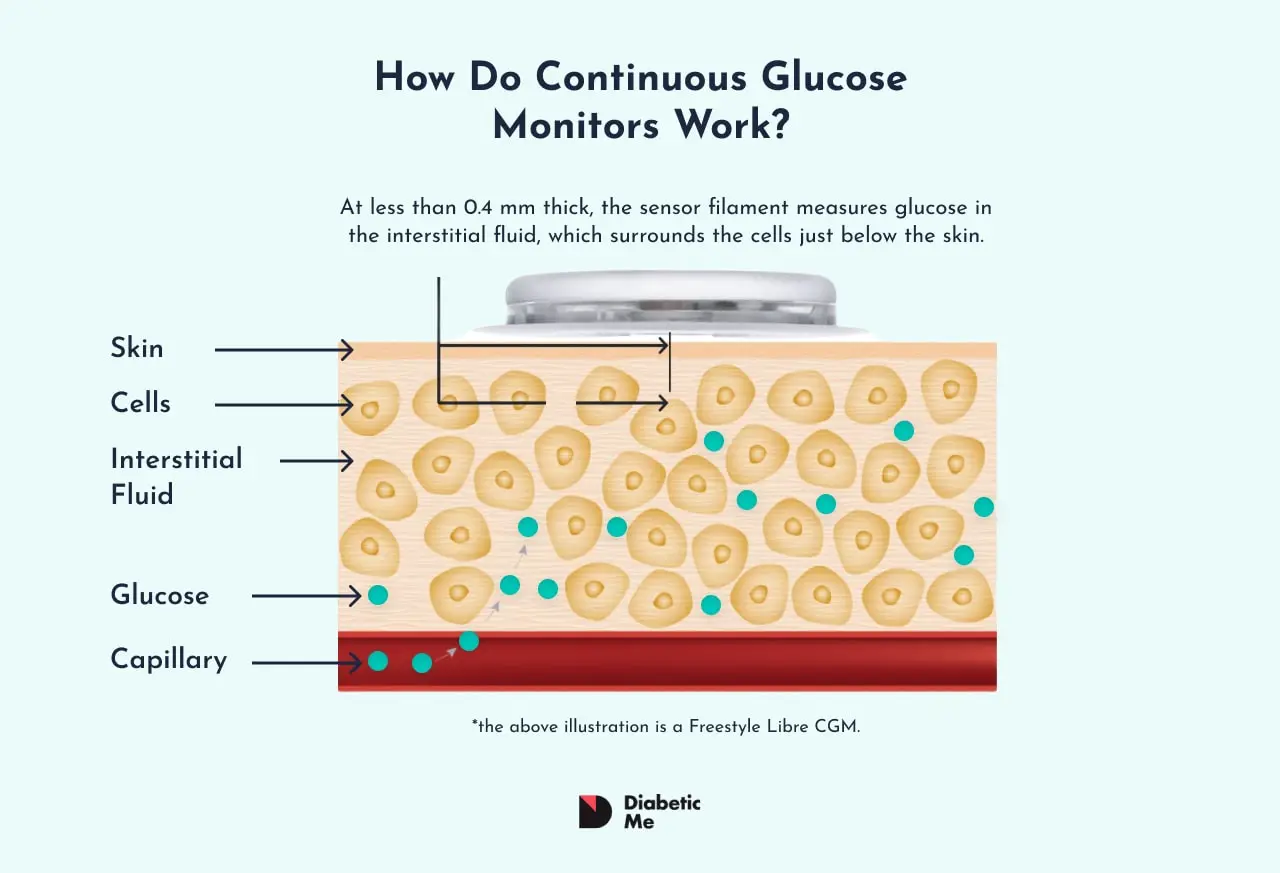
The sensor has a tiny filament that measures the sugar levels in the fluid surrounding the cells under your skin (interstitial fluid). It doesn't measure glucose levels directly through your blood. However, it alerts you of changes before they get too high or too low.
The sensor usually works every few minutes (5–15 minutes) to give you regular readings. You can easily view this data through your smartphone or CGM receiver.
3. Transmitting the Data
The sensor sends the continuous glucose data through a piece called a transmitter. Some CGMs come with a separate transmitter that you attach over the sensor after every change.
On the other hand, a few CGM models combine the transmitter and the sensor into a single assembly.
4. Receiving the Data
You can receive the data over the receiver you get with your CGM or directly to your smartphone (or any smart device). Monitoring such data can help you make treatment decisions to remain healthy.
Those readings also allow your doctor to review and download your trends to better understand your case. As a result, you can work together to improve your glycemic control and diabetes care plan.5. Changing the Sensor
CGMs are water-resistant. So, you can shower and swim without fear of losing or breaking the transmitter.
However, depending on the CGM model, you need to change the sensor every 7–14 days. It should usually be easy to do it yourself.
That said, some CGM models are long-term, which means they only need sensors changed a few times a year. Yet, inserting and replacing the sensor must be done by a licensed physician.
Why Is Continuous Glucose Monitoring Important?
Unlike traditional blood glucose meters, continuous glucose monitoring keeps you updated with your sugar levels over time. This has tremendous benefits because it helps you with the following:
1. Learning What Affects Your Sugar Levels
By monitoring your glucose levels, you can keep track of readings 24/7 without the need to prick your finger. You can also learn the type of food that makes your sugar spike and what to eat before it.
For example, research shows that eating vegetables before carbohydrates can help control postprandial glucose. As a result, you can improve your long-term glycemic control.
Similarly, some exercises can lower your glucose levels. Without continuous readings, such information is impossible to obtain. The same goes for stress, illness, sleep quality, etc.
2. Remaining in Range
Doctors always emphasize the importance of keeping diabetes patients' blood glucose levels within range. Healthy blood glucose levels are typically between 70 and 180 mg/dL.
Without CGMs, you don't usually notice getting out of range unless you decide to test yourself. Even worse, some people don't even realize it until they start showing symptoms, which can compromise their health.
3. Avoiding Serious Complications
Most CGMs can alert you when your glucose levels are out of range. You can easily set your preferred levels to get notifications early enough and make quick treatment decisions.
Blood sugar levels that are too high may put you at risk of hyperglycemia. If not treated, such conditions can lead to severe complications. Similarly, glucose levels getting too low (Hypoglycemia) can also cause serious issues.
Hyperglycemia Complications
- Problem with sight and damage to the eyes (diabetic retinopathy)
- Nerve damage (peripheral neuropathy)
- Diabetic ketoacidosis
Hypoglycemia Complications
- Seizures
- Loss of consciousness (this is quite dangerous, especially when driving)
4. Updating Your Healthcare Provider
Your doctor can download and analyze your CGM data during your visit to provide better care. Whether minor lifestyle changes or insulin dosage adjustments, your glucose trends can help your doctor make such critical decisions.
Who Benefits From Using a Continuous Glucose Monitor?
The majority of people using CGMs are those with type I diabetes. Yet, the possibility of such a device helping patients with type II diabetes is also present. That's especially effective for patients who get multiple doses of insulin daily.
CGMs are medically approved for use by adults and kids (as young as two years old). A physician may recommend a CGM for those who:
- Have hypoglycemia unawareness
- Are on tight blood sugar control
- Have high or low blood sugar often
- Have insulin resistance or are on the pre-diabetes spectrum
- Have pregestational diabetes and are on intensive insulin therapy (women)
Do All Diabetic Patients Need a Continuous Glucose Monitor?
No, they don't. Not everyone with diabetes needs to have a CGM. In fact, people with type II diabetes who aren't on multiple daily injection (MDI) insulin therapy don't need CGMs.
This includes people with type II diabetes who are on basal-only insulin treatment and those who don't use insulin at all.
Do Continuous Glucose Monitors Replace Glucose Meters Completely?
As compelling as it might seem, you shouldn't get rid of your glucose meter after getting a CGM. That's because it can still play a massive role in your treatment plan.
With a CGM attached to your body, you still need to use a glucose meter to verify the readings, especially if they show out-of-range results.
Even without any raised concerns, you may need to check the CGM. A quick blood test on a standard glucose meter tells you if it's working correctly.
Do Insulin Pumps Have Continuous Glucose Monitors?
Many people with diabetes use insulin pumps as a replacement for multiple daily injections therapy. An insulin pump provides precise doses through a cannula over your day.
Most insulin pumps don't measure glucose levels or provide insulin automatically. As a pump user, you still need to program and adjust the pump for proper dosage.
Some modern insulin pump models come with an integrated CGM. Although it may not provide all the features a separate CGM does, it's still a great option.
In all cases, you can find many insulin pumps that connect to your glucose meter or CGM and work in calibration with them.
Frequently Asked Questions
Does a CGM have a needle?
Yes, a CGM has a tiny needle to insert the CGM under the patient’s skin. The needle gets removed after inserting and a small testing strip stays under the skin.
What is needed for continuous glucose monitoring?
There are only three components needed for a CGM. These include a needle-based sensor that goes under your skin, a transmitter that attaches to that sensor, and a device that receives the data and shows it to you. This device can either be a smartphone or a receiver.
How painful is a CGM?
According to most patients, a CGM isn’t painful because its needle is tiny, so it doesn’t hurt when piercing the skin. You only feel a slightly uncomfortable pinching sensation.
How do you shower with a continuous glucose monitor?
A CGM is essentially waterproof, so you can shower and swim with it without worrying about water damage. However, some CGMs have a time limit in terms of water submersion, so it’s better to be sure before jumping into the water.
When showering, it’s better to use some kind of adhesive to make sure that the sensor stays on.
Conclusion
Modern technology can make a person's life much easier, especially in the medical field. Although some people with diabetes manage their treatment with a traditional glucose meter, others need nonstop monitoring. So, how do continuous glucose monitors work?
CGMs have a sensor that attaches to your body and measures your glucose levels regularly. This helps you maintain healthy blood sugar levels and avoid serious complications.
Sources
At Diabetic Me, we are committed to delivering information that is precise, accurate, and pertinent. Our articles are supported by verified data from research papers, prestigious organizations, academic institutions, and medical associations to guarantee the integrity and relevance of the information we provide. You can learn more about our process and team on the about us page.
- Medtronic Glucose Trends
Source: Medtronic - ScienceDirect Glycemic Control
Source: ScienceDirect - National Library of Medicine Effect of eating vegetables before carbohydrates on glucose excursions in patients with type 2 diabetes
Source: National Library of Medicine - American Diabetes Association CGM & Time in Range
Source: American Diabetes Association - Mayo Clinic Diabetic retinopathy
Source: Mayo Clinic - Mayo Clinic Peripheral neuropathy
Source: Mayo Clinic - Centers for Disease Control and Prevention About Diabetic Ketoacidosis
Source: Centers for Disease Control and Prevention - Medtronic Multiple Daily Injections Insulin Therapy
Source: Medtronic - Cleveland Clinic Insulin Pumps
Source: Cleveland Clinic

People saying CGMs are too much hassle haven’t felt the hassle of daily finger pricks. This is a game changer, no doubt. Plus, it’s not like you have to be a tech wizard to use one.
Good point, RJ_45. But still feels a bit futuristic for some of us. I guess it’s all about getting used to it.
This is intriguing. Continuous monitoring could provide valuable data for managing diabetes. However, I’m curious about user compliance and long-term benefits. Anyone have personal experiences?
im not totally sold on this. sounds expensive and like alot of hassle. anyone actually see good results with this thing?
lol does it come with a free app that tells u if u ate too many donuts??? asking for a friend haha
Okay, but how do u know when its time to change the sensor on these CGM devices? My kiddo hates any kind of doctor-y stuff, so I wanna make it as smooth as possible. Thx, Ely Fornoville for the deep dive.
Chuck, usually the device will give you a heads up with a notification or something. My daughter’s CGM beeps, so we know it’s time to switch.
Ah, gotcha, Tammy Q. Notifications make sense. Thanks for the tip!